
Beyond the Brain: The Peripheral Nervous System and the Future of Health Technology
The peripheral nervous system connects the brain to every muscle, organ, and patch of skin in the body. It is active in everyone, all the time. And it is the most underused signal in healthcare.
4 minute read

Sun loungers, MonacoYour eyes are moving across this sentence. Your posture shifted, almost imperceptibly. If you're reading on your phone, your thumb is scrolling. You decide to keep reading, or to stop. None of this required a conscious decision. It is simply your nervous system, running in the background as it has been every moment of your life. Like an electrical grid, you don't think about it until the lights go out. Without it, everything changes. The smarter we monitor it, the better we can protect, support, and treat it when something begins to fail.
When we consider the nervous system, the brain takes centre stage. With approximately 86 billion neurons, it's where all the big questions live - understanding, thought, subjective reality, behaviour and more.
At Antelope, we think that to better engage with the brain, you need to start where it ends.
Starting where the brain ends
Our brain connects to the world through the peripheral nervous system. This is a vast network of nerves that emerges from the brain (specifically called cranial nerves) and spinal cord to reach every muscle, organ, and area of skin in the body. On its own, a nerve is not a single wire but a tightly packed bundle of thousands of neuron projections called axons. Together, they act like a delivery network, shuttling information to and from their neuron bodies in the brain and spinal cord. Sensory information like light, sound, the position of your limbs, flows in. Motor commands like blink, digest, move, flow back out.
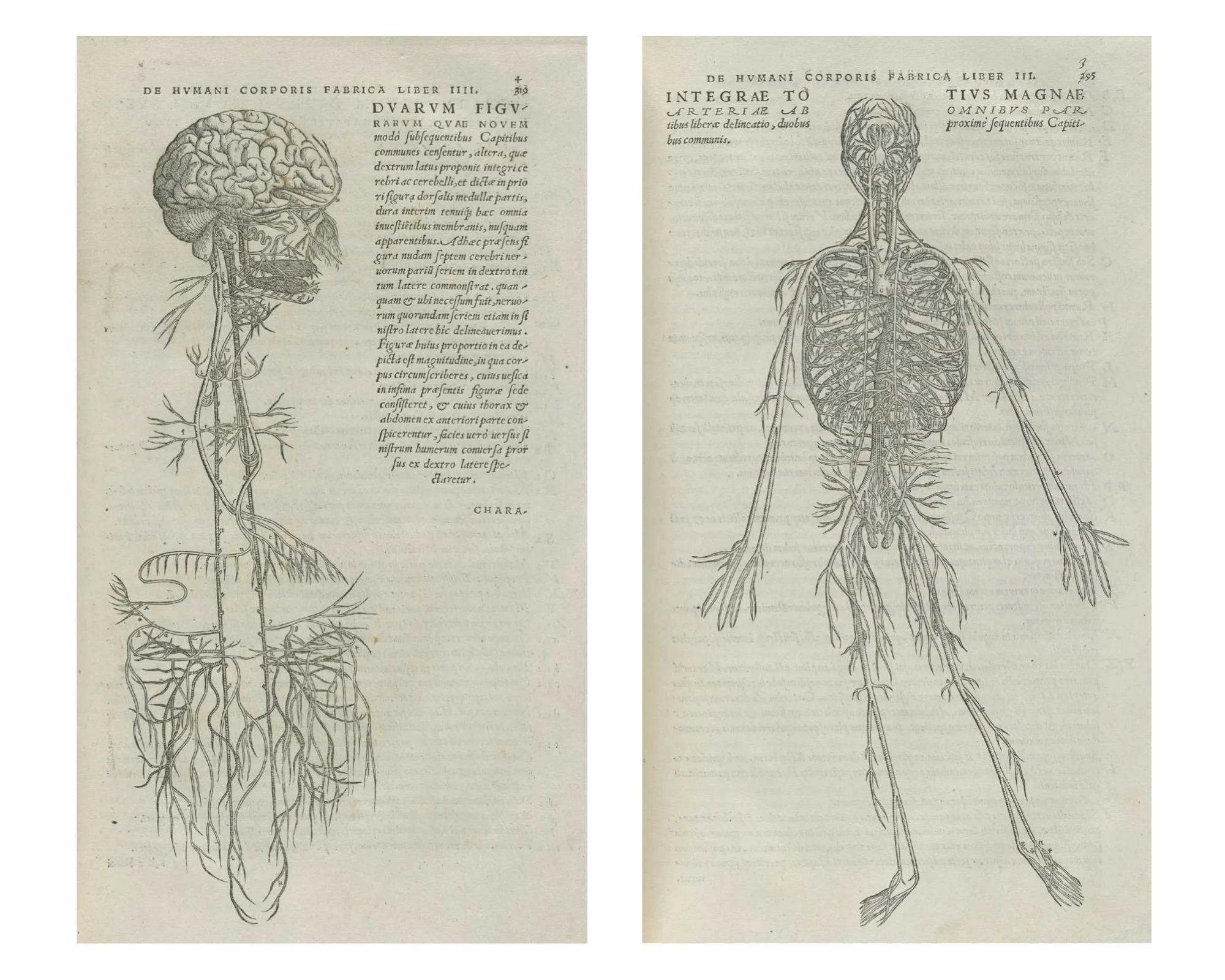
Two 16th-century illustrations by Andreas Vesalius, from De Humani Corporis Fabrica (1543) courtesy of the National Library of Medicine. On the left, the brain and cranial nerves that connect to the head, neck, and torso organs. On the right, the nerves that extend to the limbs, skin, muscles, and organs throughout the entire body. This vast network remains, nearly 500 years later, relatively underexplored by modern neurotechnology.
You have likely experienced the system misbehaving. Pins and needles after sitting awkwardly means your nerves are waking back up. They’ve been compressed, so they send odd signals until everything goes back to normal. This basic architecture is ancient. And without nerves, the brain is capable of extraordinary processing and precisely nothing else. Nerves are, relative to its importance, surprisingly underappreciated.
Years of research in neuroscience show how nerve signals connect to brain activity. Take the humble fiddler crab, with only a few hundred thousand neurons. Researchers at the Margrie Lab and Branco Lab at the Sainsbury Wellcome Centre, UCL, are studying how their nerve signals coordinate impressively complex behaviours. These small crabs live on beaches and mudflats, and when they venture out to feed, they navigate back to their burrow without ever looking directly at it. Instead, they track landmarks, monitor their own movement, and count their steps. Without that peripheral input, the central processing is useless.
Even in one of the simplest nervous systems we know of, the peripheral layer is doing critical work. Intelligence isn’t just central; it’s spread out. It lives in signals from the body, the limbs, and the environment. It’s true in a fiddler crab on a beach. It's true in a person going about their day.
The peripheral opportunity
Neurotechnology has focused on the brain and spinal cord. Researchers have long treated central neural access as the primary route to effective treatments. Cortical electrodes, deep brain stimulation, and spinal cord implants are impressive tools. However, they are invasive, specialist, and available to only a few people.
At Antelope, the peripheral nervous system offers an untapped alternative. Our nerves provide non-invasive access to the nervous system's live output. They carry transformed commands from the brain. Signals that can be recorded, decoded, and interpreted without a single incision. Nerves are present near the surface and are found in every muscle and organ. They are active in everyone all the time.
This idea of reading and writing neural commands from and onto nerves is not new. Decades of clinical use show that peripheral motor signals are clear and reliable, and can effectively control complex devices. Myoelectric prosthetics are artificial limbs that are controlled by the electrical activity of residual muscles. They have been in clinical use since the 1960s. The same principle holds on the sensory side. Devices that communicate with peripheral nerves have strong clinical roots. For example, TENS units help manage pain by modulating signals in skin nerves. Cochlear implants send sound directly to the brain via the auditory nerve. Vagus nerve stimulators are also used to treat epilepsy and depression.
For Antelope, monitoring the peripheral nervous system's input and output streams provides a clear opportunity: a signal rich enough to be meaningful, accessible enough to be useful beyond a hospital ward, and available to anyone. It allows us to work with the nervous system, not around it, to build intelligent health technology that benefits every body.